When people fall from extreme heights

I’m currently on a month of Ortho nights and was asked by the Attending to look up an article about the median lethal dose (LD50) for falls, meaning, at what height when people fall, do 50% of them die.  Although 10 years old, the article is pretty interesting and got me thinking about some fall patients I’ve taken care of in the past.  I once had a patient who accidently fell 11 stories from a hotel and lived.  But we’ll get back to that story in a bit.

A fun fact before we dive in:

The record for a fall from the greatest height where the person survived is held by Alan Magee, a WWII USAF pilot who jumped out of his plane at a startling 24,000 feet and landed in a pine forest (some sources say a glass roof).  Fortunately for him, the forest (or the roof) was covered in snow which is believed to have decreased the energy of the impact due to its deformability.  If you are looking for a great book about a fall survivor, check out When I Fell From the Sky, by Juliane Koepche, a 17 year old girl who fell 10,000 feet from her family’s airplane which ultimately crashed in the Amazon jungle in 1971.

When I Fell From the Sky (front).grid-4x2

The evidence on falls

The article, Prognostic factors in victims of falls from height, by Lapostolle et al, was published in Critical Care Medicine in 2005.  The study took place in France, in a city near Paris with a population of 1.3 million people.  The researchers worked with the local EMS agency, Service d’Aide Médicale Urgente (SAMU), to examine both pre-hospital and in-hospital mortality (death) from falls, with the goal of determining what characteristics of a fall, if any, factor into prognosis.  There were 287 patients in the study, 97 (34%) of which ultimately died.  In short, they determined that patient age, height of fall (e.g. 1 story vs 8), impact surface type (e.g. concrete vs snow) and body part that first touches the ground (e.g. head vs legs) all help predict how a patient will do.

Interestingly enough, they even looked at the circumstances leading to the fall (i.e. accident, suicide, escaping a burning building), and cause did not factor in to prognosis.  When you stop and think about it for a second, it seems semi-reasonable that someone determined to commit suicide might be able to jump in such a way to be more successful in his mission.  Yet, of the 123 patients who attempted suicide, only 45.5% were successful.  So suicide was not more deadly of a fall.

Also of interest, landing feet first was much less deadly than landing on your stomach, with death rates of 5.6% and 57.1% respectively.  Getting back to my patient who fell 11 stories and lived, he fell feet first.  I believe he survived because his legs acted as a sort of crumple zone, absorbing some of the energy of the impact.

Figure 1. Height of fall and related mortality.
Figure 1. Height of fall and related mortality. Lapostolle et al.

Figure 1 above is from the article, and shows what’s known as the median lethal dose (LD50) for falls, meaning, at what height of a fall will 50% of people die.  In this study, it was determined to be just over 4 stories.  You can see that in this study, with the exception of one person who fell 17 stories, 100% of the patients who fell from 8 stories or more died.  Clearly there are exceptions to this in real life – the 17 story patient, my patient, Mr. Magee, Ms. Keopche – but statistically speaking, it’s extremely rare.  So, next time you respond to a call or see a patient in the ED who fell 4 or more stories, know that they have a 50/50 chance of survival.


Sorry for the morbid topic, but that’s part of being on night shift I suppose.

~Steph

Interview with a Charge Nurse: How to be an EMS provider respected by the ED

I had a great response to one of my earliest posts, 5 Things I Learned in Medical School I Wish I’d Learned in EMT School, with many people asking for more tips on improving as an EMT.

Katie Arnold, Charge Nurse

With that in mind, I realized that learning how to interact with the staff in the Emergency Department (ED) is also an art not often addressed in EMS education.  Clearly you need to know and execute your protocols effectively – but how can you stand out as a respected EMS provider?  Fortunately, I’ve been friends with an awesome charge nurse named Katie Arnold since junior high.  She was kind enough to answer a few questions.


Steph: How long have you been a nurse, and how did you get to be a charge nurse?

Katie: I have been a nurse for 14 years this May 2015 – I have spent my whole career in the emergency department. I was selected for charge nurse by my manager, trained by another charge nurse and then started on my own around 2006-2007.

Steph: What do you like most about your job?

Katie: As an emergency nurse in general I love the unpredictable and unexpected. I tell new nurses, patients and their families all the time that it’s like a jigsaw puzzle: you get a piece here and a piece there but you don’t figure out the whole picture until all the pieces are in place. I love that I can have 5 patients all with the same chief complaint and each will be managed totally differently. As a charge nurse I love being a representative for the department, working with ancillary staff, patients, families, nurses, and EMS. I am there to control the flow of the department, to be a professional example for everyone and handle many administrative duties. It adds a whole other dimension to the role of nurse that allows further development of a holistic nurse.

Steph: Can you explain the goals and responsibilities of a charge nurse, in particular, ways you interact and work with EMS?

Katie: The duties are numerous and in depth. With EMS, we are the liaison between rescue and the ED. EMS providers are the eyes, ears and hands in the field; they are going to paint the picture the charge nurse needs to determine how each ambulance patient that arrives will affect the balance of the ED at every moment. You must appreciate their role in addition to the roles of the ED staff. Their resources are vastly different than the staff in the ED. I think staff nurses as well as some charge nurses lose sight of that fact.

Steph: What makes a good EMT in your mind?

Katie: A good EMT knows their role, provides an accurate concise report of what they are transporting to the ED. They demonstrate professionalism despite the stresses presented by the patient, the scene and the ED. A good EMT knows when to address concerns and when not to.

Steph: Do you have any pet peeves of EMS providers?

Katie: Lengthy reports of extraneous information and lack of recognition about valid concerns of the ED staff. One cannot expect the ED staff to appreciate EMS constraints but then not care about the concerns of the ED staff.

Steph: What can EMS providers do to make your life as a charge nurse easier?

Katie: As Charge Nurse, I have to decide what type of bed is appropriate for the patient based on the EMS report. Do they need a heart monitor, a psych bed or oxygen? Not all rooms are equipped with the same capabilities. A good report provides me with the information to make this decision. Helpful EMS providers also note when the ED is busy, and go the extra mile to be team players. Whether it’s cleaning a bed or hooking a patient up to the monitor, while not the job of the EMS provider, it helps the patient get care faster.

Steph: Which EMS providers impress you and why?

Katie: Those who are clear, concise, professional both in front of their patient and amongst colleagues on the EMS and ED side. Providers that are open to and understanding of constructive criticism.

Steph: Any tips for a brand new EMT?

Katie: I believe that when a new group of EMT’s are coming out they should have an initial interaction with a charge nurse or liaison at the ED to discuss these topics and allow for questions they may have to be asked prior to starting on the road. If that’s not done formally, then an individual EMT should feel free to introduce themselves to ED staff and seek feedback on reports.

Steph: And finally just for my own curiosity, what’s it like to be charge nurse on July 1 when the new Intern doctors start?

Katie: I love to teach and educate, so it does not bother me as it does others. ED Staff tend to become frustrated because each new class of Interns is unaware of how each ED operates with different patterns and order sets, goals and metrics. Some doctors are more receptive to that fact than others. It can drastically slow the flow of the ED and directly affect the care of the patients. New Interns are successful as long as they are willing to listen.


So there you have it, straight from the boss’s mouth.  My advice, pick one thing to try and start there.  Good patient reports are 90% of the game.  Once you nail that, the rest falls into place.

~ Steph

Did you know it’s National EMS Week?

Did you know that May 17-23, 2015 is National EMS Week?  There are over 825,000 certified EMS providers in the United States.  In addition to being an exciting job, it’s also a dangerous one – with an estimated 27,800 ED visits annually by EMS providers as patients themselves!

While donating to a local rescue squad is a great way to show your support for EMS Week, I can tell you from first hand experience that a simple gesture to say “thank you” goes a long long way to keep an EMS provider motivated and inspired.


TeamLouka Gets a Sweet “Thank You”

A few years ago on a hot Summer day, Amir and I were dispatched to a house for a child having a seizure.  The little girl had a history of frequent seizures, so her parents were pros at giving her Diastat, her emergency medication designed to stop a seizure.  By the time we arrived just a few minutes later, her seizure had stopped, and her Dad just asked that we check her vital signs.  He had spoken to her Neurologist who agreed she could stay home if her heart rate, blood pressure and breathing were all stable.  Fortunately, everything checked out ok, so the family was able to avoid another hospitalization.

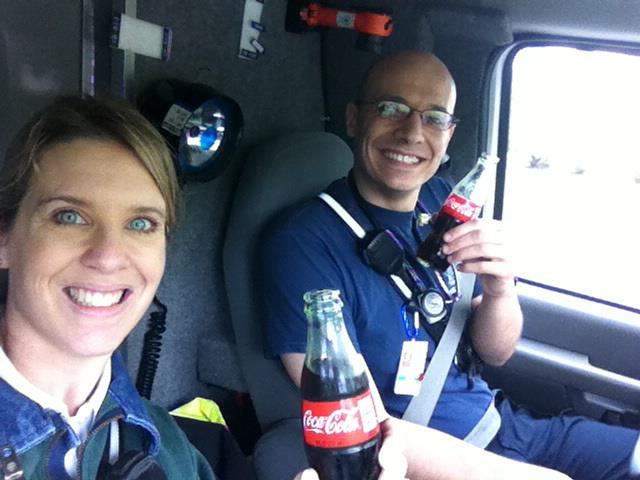
As we collected the equipment and marched back downstairs, we heard the Dad pop the top on two bottles and shout “I really want to thank you both!”  Hoping not to embarrass or insult him, Amir and I discussed the best way to tell him we couldn’t accept an alcoholic “thank you” while on duty.  As we rounded the corner to the kitchen, we saw him holding two ice-cold bottles of Coca-Cola.  We drove away feeling appreciated and recharged – ready to take on whatever 911 call came next.

255764_10151483529319545_1320742665_n
The sweetest kind of “Thank You”

Hopefully you won’t have to have such a close encounter with your local EMS providers, but don’t let that stop you from giving the next crew you see a pat on the back.

~ Steph

DIY Yard Yahtzee!

After another successful Crab Bake with Giant Jenga, I was thinking about other classic games that would translate well into a “giant” version.  Then of course I was at Target this week and came across 6 wooden blocks designed for home arts & crafts projects.  An idea was born!

IMG_2313

What you need:

  • 5 square wooden blocks (4″ cubes or larger if possible)
  • Acrylic paint in multiple colors
  • Paint brush(es)
  • A quarter or something else circular to use as a stencil for the dots
  • Mod podge or other sealant
  • Chalk board paint or pre-fab chalk board
  • White chalk
6 Wood Blocks - Target $14.99
6 Wood Blocks – Target $14.99
Mod Podge sealant - $4.99
Mod Podge sealant – $4.99
Chalkboard Paint - $9.97
Chalkboard Paint – $9.97

Step 1: Paint the base of your blocks

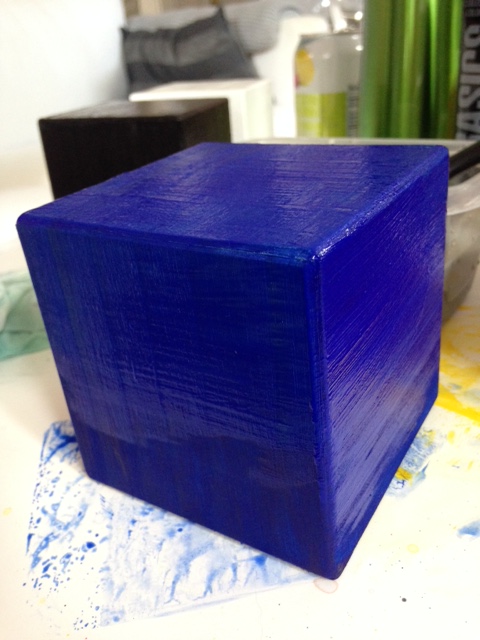
Solids are great, but you can also make each block a mini work of art.  Just remember you’ll have to apply dots as well, which might cover up some of your artwork.

IMG_0538 IMG_0536IMG_0537


Step 2: Stencil your dots

Use a quarter, glass or other round object to trace the dots onto your blocks.

die_2


Step 3: Fill in your dots

I used paint pens for ease, but you can certainly paint in your circles with a paintbrush, or make it simple and apply stickers or paper with Mod Podge.


Step 4: Seal your surface

I like Mod Podge with a gloss finish.  It’s great if you used paper or just paint to create your design.  Paint on multiple layers for a good seal as you’ll be rolling these dice in the grass and will want to be able to clean the surface.


Step 5: Create your scorecard

You can find easy, printable score sheets online, or you can keep everything large scale and create a “giant” scorecard on a chalkboard.  And, don’t forget to print the rules for Yahtzee! if your family likes to argue about technicalities.

Printable PDF score sheet
Screen Shot 2015-05-13 at 4.32.10 PM
“Giant” Chalkboard Score Sheet

Step 6: Enjoy!

IMG_2317

~Steph

Ups and Downs of My Intern Year in Emergency Medicine

Everyone warns you that Intern year is hard. It’s a year of little sleep; a rollercoaster of emotions both good and bad. Frustration and guilt in wanting to know everything NOW, because everything you don’t know might be what matters for this patient, this time. And trememndous successes. Some of the things I did this year, I really can’t believe I was able to do. And survive. Mostly, I’ve learned a lot about myself, and have been reminded yet again, that I work with an amazing group of people.


UP – Running a trauma when I thought I could never do it

I have a distinct memory of standing in the Trauma Bay at Norfolk General Hospital, watching the Trauma Team work its perfectly organized chaotic magic. I paid particular attention to the young female physician leading the whole thing – inserting an airway, calling out physical exam findings, doing an eFAST ultrasound to look for bleeding. I remember hoping, wishing I could ever have her confidence and calm demeanor. That thought was followed quickly by being thankful I wasn’t yet in that spotlight myself. I could never do that, right? In September I ran my first Delta Trauma at a Level I Trauma Center, and I survived to do it again.

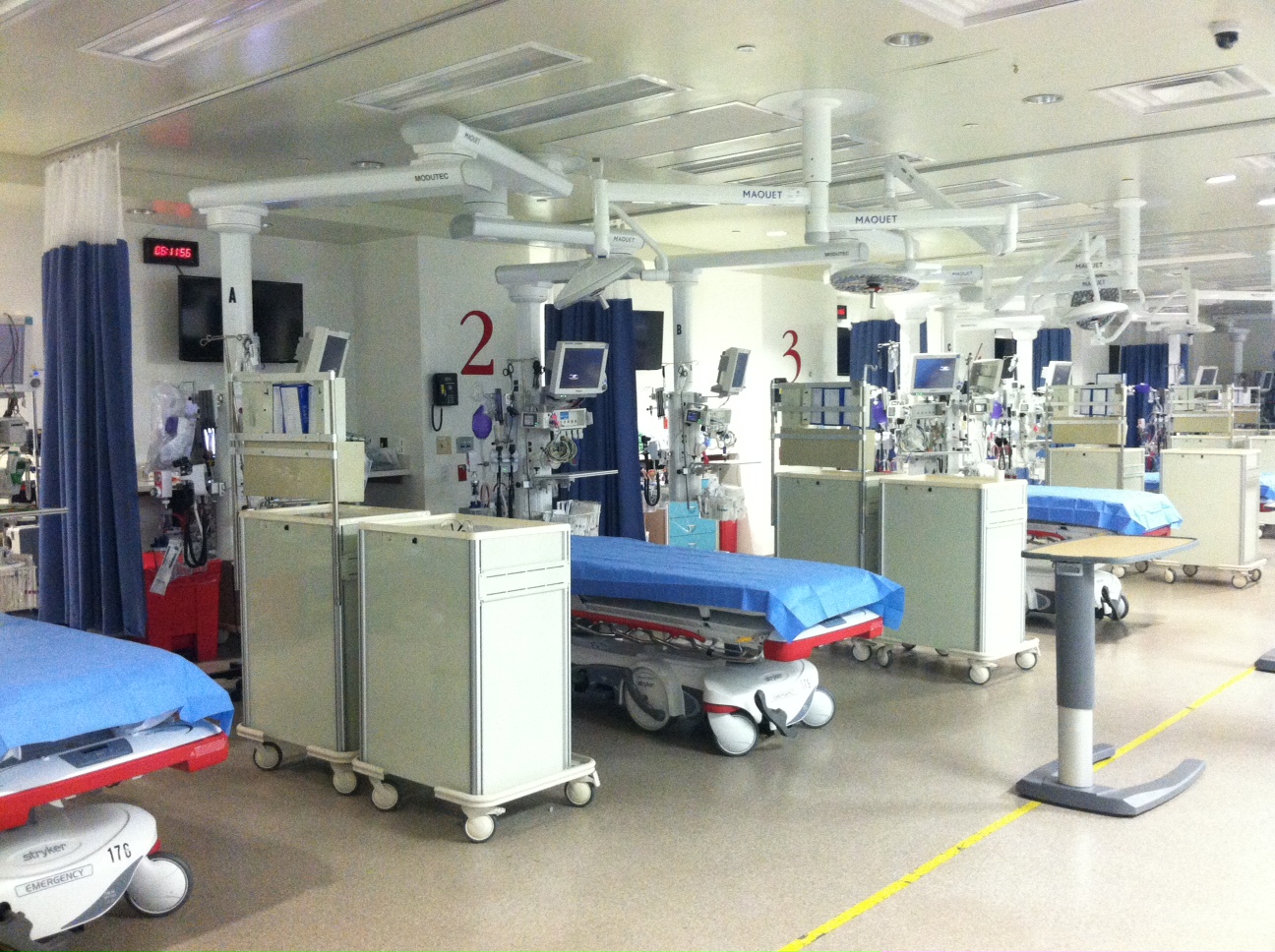
VCU Medical Center Resuscitation Bay, Richmond, VA

DOWN – Those 2-week stretches not seeing my husband

I had no idea how much I need my husband to help me feel like a normal, healthy, centered human being. Amir and I had about four 2-week stretches this year where he was on nights and I was on days, or vice versa. One day we were so desperate for a date we coordinated a 20 minute coffee meet-up at the au bon pain in the hospital. Let’s not talk about what the house or laundry pile looked like during those stretches.  This is the video we play each other if we ever need a pick-me-up:


UP – Procedures, procedures, procedures

Open Thoracotomy

Paracentesis

Lumbar Puncture

intubations, central lines, suturing, joint reductions, even a c-section… you get the idea. I get to work with my hands a lot.


DOWN – Crying in the ICU

So I’m a crier. Always have been. I have distinct memories of my dad trying to help me with math homework as a kid, me getting frustrated and crying (my stress response), and my dad getting frustrated because I was crying. “What’s crying going to solve?” he used to ask me, which of course, made me cry more.

To be honest, I was expecting to cry multiple times the first few months of residency. tumblr_inline_mhsu6v3NBF1qz4rgpI actually made it to late February before it happened. Combine working 12-14 hours a day, 11 days in a row, with little sleep, food, potty break or non-medical human interaction (one of those 2-week stretches) – and now add to that a dozen of the sickest patients in the hospital. I broke down – red face, tears, snot, the whole nine yards. The nice thing about Intern year though is that everyone around you has been there, so I had about 4 senior residents plus 3 PAs sharing their crying stories right along with me to help pick me up. And that’s what you learn to do – pick yourself up, learn and keep going.


UP – Finally learning my way around the hospital (which is actually 4 hospitals)

Anyone who works in an old hospital knows how the building just gets added onto over the years, creating a behemoth maze of windowless hallways and floors that don’t match up. “Take the elevator to the 5th floor of North Hospital, turn left and you’ll be on the 1st floor of Main Hospital.” As if there weren’t enough to learn as an Intern.


DOWN – Cancer. I diagnose a lot of cancer.

I didn’t go into Oncology for a reason. It takes the smartest, strongest, most energized people to be cancer doctors. As an Emergency Physician, I expected to treat people with cancer, but I hadn’t thought of cancer as something I would diagnose. I guess I assumed that people would present to their PCP with concerning symptoms, get an outpatient workup and diagnosis by a specialist. But people do come to the ED for hematuria (blood in the urine), anorexia (lack of appetitie), back pain and weakness. And sometimes at the end of the workup, it’s cancer.


UP – Baby Mint Mochachino for a dying patient

Baby Mint Mochachino made with honor

I’ve seen a lot of amazing, caring people do a lot of touching things in the medical setting, but one moment stands out from this year. I had a patient who had chosen to pursue hospice care. He couldn’t stop telling me how beautiful his wife was and how he looked forward to seeing her soon. He had stopped eating and drinking days ago, so when he asked me for a “real coffee,” I was intrigued. He’d requested a cup of coffee from the medical student who poured him a cup of the hospital grade mud available to all employees. His dying wish was to have a real cup of coffee. How reasonable. I went to the ABP counter, told the story to the barista, and she whipped up the only coffee worthy of such a role – a baby mint mochachino, which she made with honor and pride in her work, even adjusting the temperature down to avoid any burned tongues.


So that’s it – Intern year is coming to a close, and July 1 I’ll be a “Senior Resident,” fraught with its own challenges and lessons to be learned.