Author: Steph Louka

Stephanie is an EMS Physician and Life-Member of the Virginia Beach Volunteer Rescue Squad. She lives in Richmond, VA with her husband Amir.

Rwanda Day 2: Imbangukiragutabara

January 22, 2018

Traveler’s Rule: International travel will always be marked by adventures with foreign showers and toilets.  This morning has already held true.  Delighted to even have hot water, I prepped for my first shower.  Dr. Sudha warned us yesterday, “There may or may not be a shower curtain, so make sure you put some towels on the floor to catch the water.”  No problem, I thought.

It took 3 full-sized towels to mop up the lake on the floor.  If I were wise, I would have toweled myself off and then cleaned the floor.  Air-dry it is.

I woke up at 4:30am Kigali time (9:30pm EST) and couldn’t fall back asleep.  For a second, I was startled by the mosquito net I’d wrapped myself in just a few hours earlier. I can get pretty claustrophobic at times.  This might be one of them.

Breakfast is served each morning at our hotel, buffet style.  As I’m writing and waiting to meet the team, I can hear the staff singing as they prepare the morning meal. I’m counting down the minutes until 6:00am when I get to experience my first cup of Rwandan coffee.

Breakfast did not disappoint.  I’ll be eating fresh fruit and coffee for the rest of the trip each morning.

We walked up the hill from our hotel to the University Central Hospital of Kigali (CHUK) to join the team for 7:00am rounds on the patients in the Emergency Department.  Dr. Noah, the ED Attending, is a US-trained Emergency Physician who is here for 7 years helping Rwanda reestablish its healthcare system.

After the genocide in 1994, many of the country’s doctors were either killed or fled the country secondary to the violence.  That left a huge deficit in trained personnel that the country has been working to fill ever since.  Grants have allowed many US physicians to come here and train the residents in an effort to rebuild.  Rwanda opened its second medical school a few years after the genocide and plans to open a third in the near future. They have made amazing strides in a short time.
IMG_0575
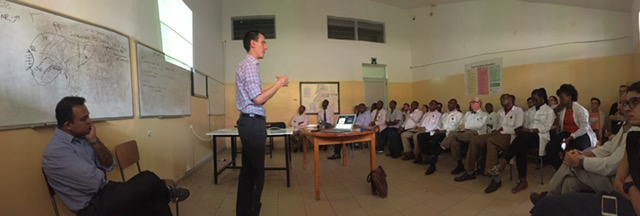
Dr. Noah facilitates a Resident discussion on end of life decisions and medical ethics

While I generally hate rounds (there’s a reason I chose Emergency Medicine), these were not your typical boring, Internal Medicine-type Rounds.  The ED is organized into 4 large rooms, each with multiple beds with short curtains separating each.
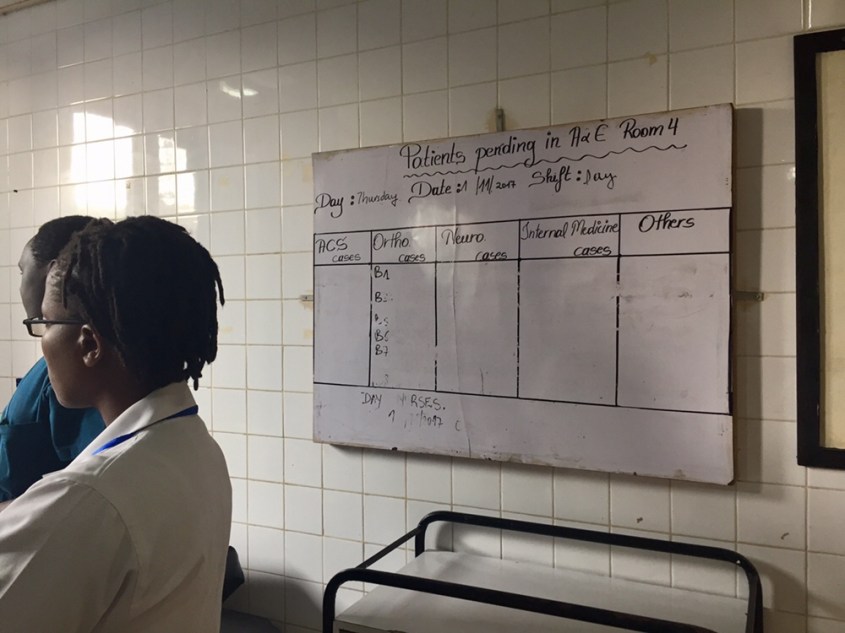
The RED room is the resuscitation room for the sickest patients and contains 4 ventilators, one of which is currently out of service.  I’m told the others are intermittently reliable. Resources are limited but they are providing excellent care with what they have.  There we find multiple patients suffering from opportunistic infections, attributed to their HIV.  There’s a YELLOW room with 6 beds.  When RED patients improve, they are transitioned to this room.  Here we found multiple patients suffering from trauma related mostly to the high rate of MVCs as I mentioned yesterday.

In bed 3, there’s a 38 year old man who was injured when a tree branch he was cutting fell on his neck, severing his spinal cord, resulting in quadriplegia.  Rounds are conducted in English, but most of the patients we care for speak Kinyarwanda, Swahili or perhaps French.  In a language I assume he doesn’t understand, we discuss his poor prognosis, as Rwanda has no long-term care facilities with spinal cord units, and motorized wheelchairs are a luxury available only to the super-wealthy.

He lays there on his back, with a cervical collar in place, staring at the ceiling and unable to make eye contact with us.  We don’t speak to him, rather just about him, and I wonder if he understands his prognosis.  I took a step forward, perhaps to make the interaction less cold, and realized he was crying.  Although he’s stable right this moment, he’ll likely die in a week.

In room 3, the GREEN room, we meet a man who has suffered a femur fracture after a motorbike accident.  He’s in the minority here as he has no insurance.  Rwanda has a public insurance program where citizens pay minimal monthly fees, and if care is needed, the government pays 90% and the patient 10%.  5-10% of Rwandans choose not to participate, and unfortunately for this gentleman, he is in that minority.  Unless in the case of true life threatening emergencies, labs and imaging are not ordered, medications withheld and surgeries postponed until the patients pay.  Because of this, patients can spend days, weeks and in one case relayed to me, a month waiting to gather the required funds.

This man has no insurance and has no family or support system that could assist him with funding.  He needs an orthopaedic surgery to install a metal plate to reattach the two ends of his femur.  “Should we consider taking up a collection again?” offers Dr. Noah, and I realize this is a common challenge.  We realize we aren’t going to solve this man’s problems quickly, and move on to the next bed to keep Rounds moving along.

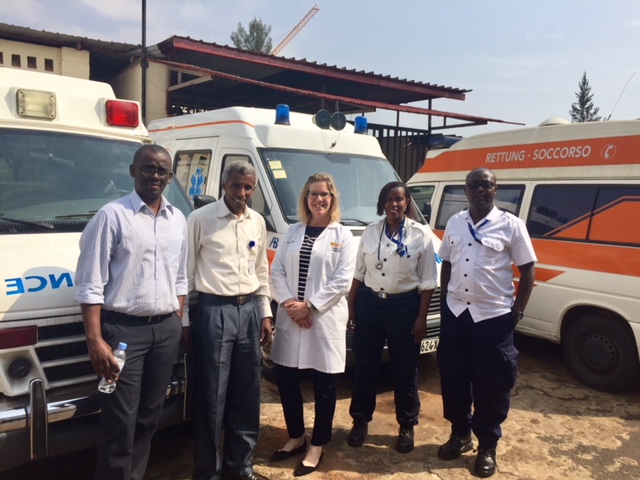
After rounds we made our way just outside of the Emergency Department to Service d’aide médicale urgente (SAMU), the country’s ambulance service.  Rwanda is 1/4 the landmass of Virginia, with a population nearly equivalent to that served by the Old Dominion EMS Alliance (ODEMSA), our regional EMS alliance for Central Virginia.  SAMU staffs nurses and nurse anesthetists on the ambulance.  Their training in prehospital medicine and trauma is minimal and variable, as there’s no standardized curriculum such as EMT and Paramedic.  Most of the nurses and CRNAs worked in the ED prior to SAMU.  The CRNAs can intubate and manage advanced medications, but the nurses cannot.

The ambulance bay contains a hodge-podge of ambulances – one way past its prime and slated for auction, another with random German writing which was donated, and another that could rival any newer model ambulance in the US.  They utilize SUVs as smaller transport units, the backs of which look quite similar in setup to a medical helicopter.  No CPR in these I’m afraid, but they look pretty darn cool and provide versatility in the crowded streets.

On the side of each ambulance is “Imbangukiragutabara,” meaning “Fast to Save.” We asked for help pronouncing it.

Because of their compact size, there’s really not room to ride along as an observer on the ambulance.  I did however get to see the 912 (their 911) Dispatch Center that services the entire country.  Calls come in from both landlines and cellular phones, but pinning down the exact location of the patient who needs care is challenging for many reasons:

  1. Most houses don’t have numbers.  Most callers are members of a citizen brigade of non-medical personnel who live out in all the villages and volunteer their time to help with emergencies.  Fortunately these volunteers know their neighborhoods inside and out, and can take SAMU to the patients.
  2. Cell phone calls don’t send the dispatcher any location data. In the US, we have federal regulations (Enhanced 911), mandating the data that cell phone carriers must provide to 911 centers. This doesn’t exist here.
  3. Cell phone calls frequently disconnect.  In the US, if this happens, the dispatcher can redial the initial number that called.  Rwanda 912 will also try to call back, but if no one picks up, there is nothing they can do after that.  In the US we often do location welfare checks if calls disconnect, but without early transmission of location data, this option disappears.
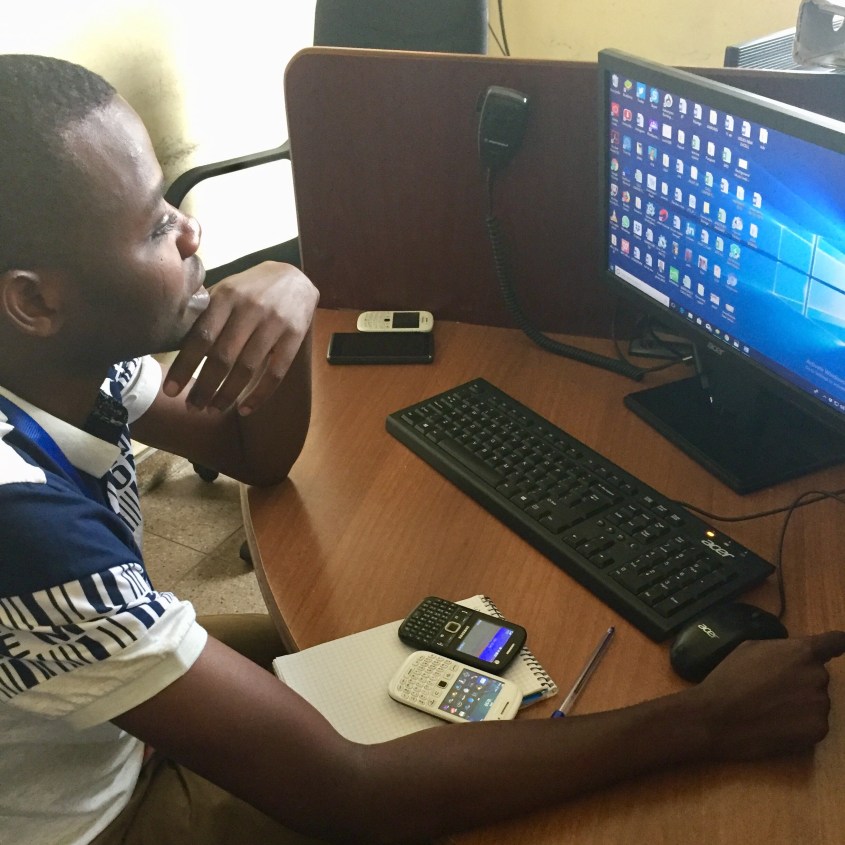
The 912 call center for Rwanda. Calls come into the white phone. Calls roll over to the black phone if the white phone is busy.

I had more to add for the day, but the WiFi has slowed to a crawl, and I need some sleep before tomorrow.  Our day is packed with plans to visit the Ministry of Health, prepare the equipment for our course, and see the Genocide Museum.

~Steph

IMG_0576
Oxygen tanks supplying the ORs
IMG_0551
Ambulances are well-stocked and organized

IMG_0556IMG_0563IMG_0558


Explore other days in Rwanda:

Rwanda Day 1 | Rwanda Day 3 | Rwanda Day 4 | Rwanda Day 5 | Rwanda Day 6 | Rwanda Day 7 | Rwanda Day 8 | Rwanda Day 9 | Rwanda Day 10/11

Rwanda Day 1: Getting there is half the fun!

Jan 20, 2018

Coordinating the safe and timely travel of 2 physicians, 2 paramedics/RNs and 1 Rotarian from 2 different states and 3 different cities is no small undertaking. In addition to personnel, we had the added challenge of getting 300+ pounds worth of medical training equipment including CPR mannequins, needle decompression trainers and oxygen bottles to Rwanda with us. We found out about 4 weeks before we were to fly that these things aren’t readily available for purchase where we are headed.

We are going to Kigali, the capital of Rwanda, to teach. Our mission is to help build and solidify a formal EMS system with top-notch Prehospital trauma care. Ambulances in Kigali are currently operated by SAMU, but the providers are nurses rather than Paramedics or EMTs. That’s because there are no formal EMS certifications or programs there. Our aim is to provide the current workforce with prehospital-specific trauma training to improve provider safety. 50% of all EMS calls in Kigali are for motor vehicle collisions (MVCs). MVC trauma is a major cause of morbidity and mortality across Rwanda.

We carpooled from Richmond to Dulles. Basil, the creator of the Trauma Course content, was kind enough to offer up his Ford Explorer. More challenging than the traffic on I-95 though, were the back seat drivers offering our opinions on the best route. Dr. Sudha, a Trauma Surgeon and myself, an Emergency Physician – we are accustomed to being the pilots.

Fortunately the traffic gods showed us mercy, and we arrived at Dulles slightly ahead of schedule. The next challenge – get the 300+ lbs of luggage and equipment from the Explorer into the international terminal. It didn’t take long for the bellcap to notice me struggling to hoist a gigantic red backpack onto my back while desperately reaching for my rollerbag that was attempting to escape into traffic. He hurried towards us with his cart and began stacking our ridiculous assemblage of oversized bags. I can only imagine what he thought of us – between the bags marked “adult/child/infant” and “torso,” he must have thought we were body smugglers or really bad parents.

Inside the terminal, he unloaded our bags. I reached for some cash, knowing I was one of the few of us with smaller bills. In our pre-trip prep, Sudha advised us ahead of time to get $100 bills from the bank. In Rwanda, the larger the bill, the higher the exchange rate. I handed him the money and was met with a confused look. “Not enough, I said?” feeling confused and bordering on embarrassed. He mumbled something unintelligible but his face told me it wasn’t good. Frank, the Rotarian accompanying us on the trip, quickly slipped him more cash, which seemed to placate him as he then scurried away.

I have Dr. Sudha to thank for the opportunity to be on this trip. She’s a fellowship trained Trauma Surgeon with a focus on International Medicine. She and I have worked together for over three years in the Emergency Department at VCU taking care of trauma patients who suffer accidents and injuries throughout Central Virginia. She first travelled to Rwanda 7 years ago during her fellowship and has since made over 20 separate trips. (I get the sense she just stopped counting at some point). In October 2017, she was awarded 3 grants totaling over $700,000, one of which was from Rotary International; hence Frank’s presence with us on the trip. If you know her, you understand why she was trusted with so much money. She’s just impressive.

The 5th person travelling with us is Jane. A nurse and a volunteer paramedic in Deltaville, VA, Jane worked at VCU for years in multiple capacities. Over time, she’s carved out a niche in International EMS, so she was an obvious choice for the team.

IMG_3265
Frank, Jane, Stephanie, Sudha and Basil

At the KLM* counter, we were met with friendliness and curiosity regarding our absurd quantity of baggage. We opted to check the medical equipment and carry-on our personal belongings. We didn’t want to take a gamble on the reliability of baggage transfer from Amsterdam to Kigali and end up with endotracheal tubes but no underwear.

I’ve decided for the privacy of those with me on the trip that I won’t include them from here on out. After all, this is just my perspective, and I don’t want to give the false appearance that I speak for anyone else. I will say I’m with a unique group of people and look forward to getting to know these like-minded folks. At dinner Dr. Sudha asked if we’d rather spend our 2 days off on a safari or at museums. The reflexive and immediate consensus was “SAFARI!” I knew then this was going to be a great trip.

*Bonus points for the free drinks on KLM.


Jan 21, 2018

“Day 2” is a bit of a misnomer. Technically it’s the 21st, but only because we just jumped ahead 6 hours by time zone. That didn’t stop KLM from feeding us breakfast just 1.5 hours after we’d eaten a full dinner.

We landed in Amsterdam without a hiccup. The last time I was in this airport was December of 2002. I’d just spent 5 months living in Spain, taking advanced conversational Spanish classes.   What I didn’t realize then was just what a turn my life would take. I’d gone to Spain for a reset. I’d hit some professional hiccups in my last job and went to Spain, I thought, to do the study abroad I never had the chance to do while at UVA. Yes, I became fluent in Spanish, but I also found myself and my way forward.

What’s amazing about your twenties is the same thing that makes that time very lonely. You’ve left the nest, launched into a wide-open world full of opportunity, choices and possibilities. But you’ve left your nuclear family. And unlike decades prior, your independence isn’t quickly followed by love, marriage and establishment of your own nuclear family. There’s a gap now, a road with thousands of potential turns, each of which could lead to an entirely different life. Endless opportunity can be paralyzing. After standing at that airport, I came home, applied for and landed a job, which resulted in a successful career in Internet Marketing. I also joined my local rescue squad.

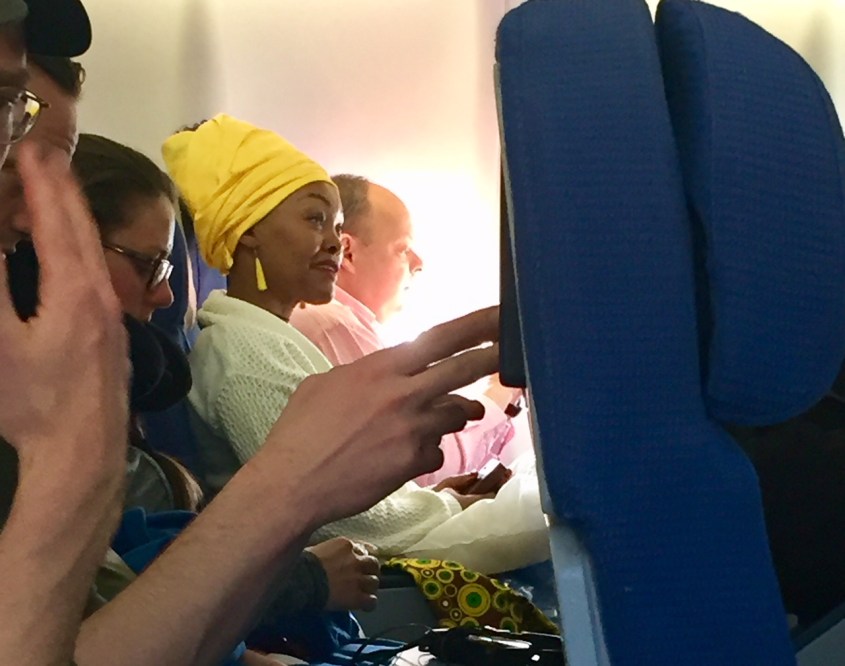
The view from the window on this leg of our journey, Amsterdam to Kigali, can be summed up in one word: tan. I finally gave in to my body’s repeated requests and took a 2 hour nap. Since waking up, I’ve seen nothing but desert. I did have a view of a beautiful part of Africa on the plane itself. Wearing a handmade, yellow and green gown with her hair secured tightly in a bright yellow wrap, everyone’s eyes focused on this woman when she appeared at the boarding gate. I looked down at my hold-over maternity pants and Merrill shoes and suddenly felt boorish and underdressed.

IMG_0492

We arrived on time into Kigali.  I had hoped for daylight as we landed so I could take an aerial survey of the city, but this close to the equator, night overcomes day very quickly,  with sunsets happening in about 10 minutes from daylight to darkness.

We’re staying at the Gloria Hotel , which is just the right combination of nice but not stuffy.  My only regret again is that it’s dark, and I can’t fully appreciate everything the area has to offer.   I’m settling into my room as we have a long day tomorrow spending time in the Emergency Department, on the SAMU ambulance, and hopefully paying our respects at the Genocide Museum

~Steph


Explore more days in Rwanda:

Rwanda Day 2 | Rwanda Day 3 | Rwanda Day 4 | Rwanda Day 5 | Rwanda Day 6 | Rwanda Day 7 | Rwanda Day 8 | Rwanda Day 9 | Rwanda Day 10/11

50th Anniversary Video of Gary & Kaye Krebs

I put this video together last year for my parent’s 50th Wedding Anniversary. I’m moving it here for hosting as YouTube took it down a few weeks ago citing copyright concerns. I guess my 212 views were a threat.


~Steph

EpiPen cost soars 400%: Implications for EMS and the ED

I had a patient last week brought into the Pediatric ED for an allergic reaction. The child had known allergies, and by the EMR, had been prescribed an EpiPen by the Pediatrician – but mom said she didn’t have one at home to use. “We have insurance, but when I tried to fill the prescription, they wanted $620! I just can’t afford that,” she apologetically told me. I sat there in disbelief, assuming she had crappy insurance.

Flash forward three days later when the news hits the mainstream media:

“EpiPen price hike has parents of kids with allergies scrambling”

“Why did Mylan hike EpiPen prices 400%? Because they could”


Prehospital Implications

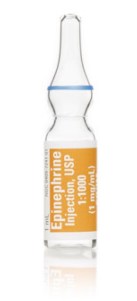
AEMTs and Paramedics, better check that drug box twice for your 1:1000 epi vials because you’ll be using them more often for anaphylaxis as parents and patients increasingly forgo the EpiPen. With a $400-$650 price tag (with insurance), and a 1 year expiration date, can you blame them? I certainly don’t.  So brush up on your local protocols, and stay vigilant. For a good review on anaphylaxis, check out this post.

0011445_01


Emergency Department (ED) Implications

As with prehospital providers, we too need to be ready with the IM epinephrine.  It’s always been recommended after EpiPen administration for patients to come to the ED  to be observed for 4-6 hours in case they need a redose of epinephrine.  As patients increasingly skip that first dose, we should expect more potential for respiratory distress and need for difficult airway management.


EpiPen Alternative

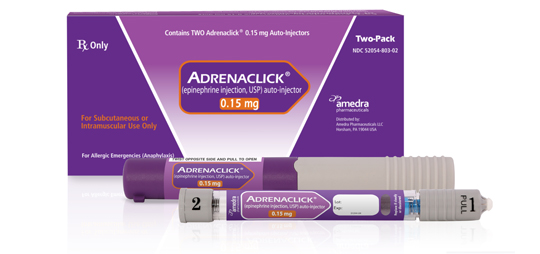
Thanks to the Facebook Group EM Docs, I learned of AdrenaClick, a reasonable alternative we can prescribe for patients with severe allergies.  The mechanism of delivery is slightly different than the EpiPen (two caps to remove instead of one), but given that it’s 1/4 the cost – it’s what I’ll be prescribing moving forward.  AdrenaClick has a good training video on their website with detailed instructions for use.  With a coupon from GoodRx, AdrenaClick is available for as low as $141.67 at Wal-Mart.  It’s still more than the original $57 cost of an EpiPen when acquired by Mylan, but better than current EpiPen prices.

body-what-is-epi-options-15mg2


If you want to learn more about the skyrocketing prices of the EpiPen and the not-so-coincidental tie to congressional mandates requiring EpiPens (like AEDs) in schools, check out this article on Bloomberg.

<Disclaimer> And, of course, I do not endorse the efficacy of, nor am I paid by AdrenaClick. They just happen to be the only other comparable epi auto-injector on the market right now.  <Disclaimer />

~Steph