
Tag: EMS

A few thoughts on drowning events

For 8 amazing summers, I worked as a lifeguard at Ocean Breeze Waterpark in Virginia Beach, VA.  Some of the best memories in my life are from those days.  However, unlike most lifeguard jobs – we actually saved drowning people, and A LOT of them, roughly 10-12 per day. I stopped counting my “saves” somewhere around 300.  Looking back, this job was what lead me to EMS, and ultimately to becoming an Emergency Physician.  The training provided by  Ellis & Associates (E&A) created a great foundation of water rescue, first aid, CPR and leadership skills.

E&A Eastern Regional Lifeguarding Competition - Summer 1998
E&A Eastern Regional Lifeguarding Competition, 1998

On a side note, you may be wondering how so many people can get into trouble at a water park.  It’s not like the ocean, right?  Well, I think as a society we have an inherent respect, and maybe some fear, of the ocean.  Pools however, are clear and don’t have critters, so how dangerous can they be?  People and parents let their guard down and get into trouble.


Are you a good lifeguard?

Before you read any further, I encourage you to take a little test.  The two videos below both feature wave pools where there are active drowners.  It’s like a high-stakes Where’s Waldo – can you spot the drowning victim?  See if you could do the job.

Did you see the kids before the lifeguard blew the whistle to jump in?  The kid in the first video has pretty obvious flailing; the kid in the second video – much more subtle.  There’s been a great Slate.com article circulating around Facebook the last few months creating awareness that drowning doesn’t always look like what we expect.


Drowning Definitions

Before we get too deep into the medicine, let’s first talk terminology.  Many of the terms I learned as a lifeguard have fallen out of favor in the medical community.

Drowning: a process resulting in primary respiratory impairment from submersion/immersion in a liquid medium

The Drowning Process: the period beginning with submersion into liquid, followed by breathholding.  As oxygen is depleted and CO2 can’t be expired, the patient begins developing hypercarbia (high CO2), hypoxemia (low O2), and acidosis.  As water is inhaled, the larynx spasms shut, blocking the exchange of air.  As oxygen drops further, the laryngospasm relaxes, and the patient breathes water into the lungs. Recovery from the drowning process depends on when interventions are made and the resultant level of hypercarbia, hypoxemia, acidosis and encephalopathy.
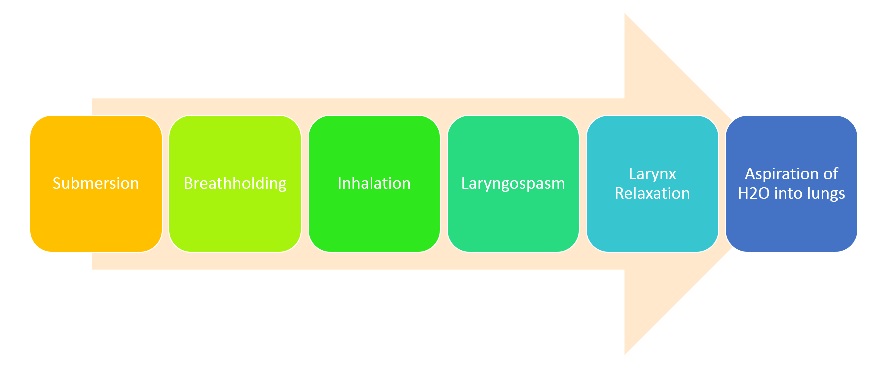
drowning process
The Drowning Process

Terms no longer used:

“Dry drowning” versus “wet drowning”: all drownings require some level of liquid, so they are all technically wet.  What was traditionally called a “dry drowning” was just someone who made it to the laryngospasm step but no further because they left the water.  “Wet drownings” went through a laryngospasm period, but advanced in the process to include inhalation of water into the lungs.


Managing Drowning Victims

You should of course follow your local protocols, but let’s talk about how the drowning mechanism affects care.  Clearly if the victim has no pulse, you’ll follow ACLS/BLS guidelines and start CPR.  If you get to a victim but can’t initiate chest compressions right away because you are oh I don’t know – in the middle of the ocean or a wave pool – at least try to give rescue breaths as you bring the victim to a more suitable place.  Remember, drowning is primarily an airway issue, so any early airway interventions will be beneficial until you can start CPR.  As of the 2010 AHA CPR updates, abdominal thrusts in a coding patient have been discarded for good old chest compressions.  So, if your drowning victim isn’t breathing, even if they have a pulse you may need to do chest compressions for management of A&B.

Regarding when to intubate, per UptoDate, “in the symptomatic patient, indications for intubation include the following:

  1. Signs of neurologic deterioration or inability to protect the airway
  2. Inability to maintain a PaO2 above 60 mmHg or oxygen saturation (SpO2) above 90 percent despite high-flow supplemental oxygen
  3. PaCO2 above 50 mmHg” which is typically unavailable prehospital.

Whether someone was pulled from fresh or salt water is not particularly relevant to prehospital care as it doesn’t change management. Consensus used to be the patients in salt water were at risk for massive pulmonary edema and electrolyte imbalance in the blood as the high sodium content of the salt water shifted in the body.  The risk and consequences of these shifts are now less worrisome than once thought.  In a 150lb (70kg) person, it actually takes inhaling 5.5 cups of water before you’ll see osmotic water shifts in the body, and twice that before you’ll see electrolyte shifts.

The greatest risk of drowning of any type is hypoxemia leading to brain damage, and they key strategy is drowning prevention.


Drowning Prevention

Prevention is by far the best strategy in managing drowning, and in the last 20 years, smart safety measures and public education programs have helped drop the overall incidence of drowning by 9%, which includes a 45.6% drop for infants (< 1 yr of age).  In fact, my good friend David Andrews who runs a water park out in California, told me that since the water park industry implemented a policy requiring kids <48″ to wear life jackets, active drowning events have declined roughly 50%.


So, if you are taking care of a drowning victim in your ambulance or ED, just follow your ACLS protocols.  And, next time you are at the water park or pool, thank the lifeguard for their diligence and dedication, and please don’t complain that your kid has to wear a lifejacket.

~Steph

When people fall from extreme heights

I’m currently on a month of Ortho nights and was asked by the Attending to look up an article about the median lethal dose (LD50) for falls, meaning, at what height when people fall, do 50% of them die.  Although 10 years old, the article is pretty interesting and got me thinking about some fall patients I’ve taken care of in the past.  I once had a patient who accidently fell 11 stories from a hotel and lived.  But we’ll get back to that story in a bit.

A fun fact before we dive in:

The record for a fall from the greatest height where the person survived is held by Alan Magee, a WWII USAF pilot who jumped out of his plane at a startling 24,000 feet and landed in a pine forest (some sources say a glass roof).  Fortunately for him, the forest (or the roof) was covered in snow which is believed to have decreased the energy of the impact due to its deformability.  If you are looking for a great book about a fall survivor, check out When I Fell From the Sky, by Juliane Koepche, a 17 year old girl who fell 10,000 feet from her family’s airplane which ultimately crashed in the Amazon jungle in 1971.

When I Fell From the Sky (front).grid-4x2

The evidence on falls

The article, Prognostic factors in victims of falls from height, by Lapostolle et al, was published in Critical Care Medicine in 2005.  The study took place in France, in a city near Paris with a population of 1.3 million people.  The researchers worked with the local EMS agency, Service d’Aide Médicale Urgente (SAMU), to examine both pre-hospital and in-hospital mortality (death) from falls, with the goal of determining what characteristics of a fall, if any, factor into prognosis.  There were 287 patients in the study, 97 (34%) of which ultimately died.  In short, they determined that patient age, height of fall (e.g. 1 story vs 8), impact surface type (e.g. concrete vs snow) and body part that first touches the ground (e.g. head vs legs) all help predict how a patient will do.

Interestingly enough, they even looked at the circumstances leading to the fall (i.e. accident, suicide, escaping a burning building), and cause did not factor in to prognosis.  When you stop and think about it for a second, it seems semi-reasonable that someone determined to commit suicide might be able to jump in such a way to be more successful in his mission.  Yet, of the 123 patients who attempted suicide, only 45.5% were successful.  So suicide was not more deadly of a fall.

Also of interest, landing feet first was much less deadly than landing on your stomach, with death rates of 5.6% and 57.1% respectively.  Getting back to my patient who fell 11 stories and lived, he fell feet first.  I believe he survived because his legs acted as a sort of crumple zone, absorbing some of the energy of the impact.

Figure 1. Height of fall and related mortality.
Figure 1. Height of fall and related mortality. Lapostolle et al.

Figure 1 above is from the article, and shows what’s known as the median lethal dose (LD50) for falls, meaning, at what height of a fall will 50% of people die.  In this study, it was determined to be just over 4 stories.  You can see that in this study, with the exception of one person who fell 17 stories, 100% of the patients who fell from 8 stories or more died.  Clearly there are exceptions to this in real life – the 17 story patient, my patient, Mr. Magee, Ms. Keopche – but statistically speaking, it’s extremely rare.  So, next time you respond to a call or see a patient in the ED who fell 4 or more stories, know that they have a 50/50 chance of survival.


Sorry for the morbid topic, but that’s part of being on night shift I suppose.

~Steph

Interview with a Charge Nurse: How to be an EMS provider respected by the ED

I had a great response to one of my earliest posts, 5 Things I Learned in Medical School I Wish I’d Learned in EMT School, with many people asking for more tips on improving as an EMT.

Katie Arnold, Charge Nurse

With that in mind, I realized that learning how to interact with the staff in the Emergency Department (ED) is also an art not often addressed in EMS education.  Clearly you need to know and execute your protocols effectively – but how can you stand out as a respected EMS provider?  Fortunately, I’ve been friends with an awesome charge nurse named Katie Arnold since junior high.  She was kind enough to answer a few questions.


Steph: How long have you been a nurse, and how did you get to be a charge nurse?

Katie: I have been a nurse for 14 years this May 2015 – I have spent my whole career in the emergency department. I was selected for charge nurse by my manager, trained by another charge nurse and then started on my own around 2006-2007.

Steph: What do you like most about your job?

Katie: As an emergency nurse in general I love the unpredictable and unexpected. I tell new nurses, patients and their families all the time that it’s like a jigsaw puzzle: you get a piece here and a piece there but you don’t figure out the whole picture until all the pieces are in place. I love that I can have 5 patients all with the same chief complaint and each will be managed totally differently. As a charge nurse I love being a representative for the department, working with ancillary staff, patients, families, nurses, and EMS. I am there to control the flow of the department, to be a professional example for everyone and handle many administrative duties. It adds a whole other dimension to the role of nurse that allows further development of a holistic nurse.

Steph: Can you explain the goals and responsibilities of a charge nurse, in particular, ways you interact and work with EMS?

Katie: The duties are numerous and in depth. With EMS, we are the liaison between rescue and the ED. EMS providers are the eyes, ears and hands in the field; they are going to paint the picture the charge nurse needs to determine how each ambulance patient that arrives will affect the balance of the ED at every moment. You must appreciate their role in addition to the roles of the ED staff. Their resources are vastly different than the staff in the ED. I think staff nurses as well as some charge nurses lose sight of that fact.

Steph: What makes a good EMT in your mind?

Katie: A good EMT knows their role, provides an accurate concise report of what they are transporting to the ED. They demonstrate professionalism despite the stresses presented by the patient, the scene and the ED. A good EMT knows when to address concerns and when not to.

Steph: Do you have any pet peeves of EMS providers?

Katie: Lengthy reports of extraneous information and lack of recognition about valid concerns of the ED staff. One cannot expect the ED staff to appreciate EMS constraints but then not care about the concerns of the ED staff.

Steph: What can EMS providers do to make your life as a charge nurse easier?

Katie: As Charge Nurse, I have to decide what type of bed is appropriate for the patient based on the EMS report. Do they need a heart monitor, a psych bed or oxygen? Not all rooms are equipped with the same capabilities. A good report provides me with the information to make this decision. Helpful EMS providers also note when the ED is busy, and go the extra mile to be team players. Whether it’s cleaning a bed or hooking a patient up to the monitor, while not the job of the EMS provider, it helps the patient get care faster.

Steph: Which EMS providers impress you and why?

Katie: Those who are clear, concise, professional both in front of their patient and amongst colleagues on the EMS and ED side. Providers that are open to and understanding of constructive criticism.

Steph: Any tips for a brand new EMT?

Katie: I believe that when a new group of EMT’s are coming out they should have an initial interaction with a charge nurse or liaison at the ED to discuss these topics and allow for questions they may have to be asked prior to starting on the road. If that’s not done formally, then an individual EMT should feel free to introduce themselves to ED staff and seek feedback on reports.

Steph: And finally just for my own curiosity, what’s it like to be charge nurse on July 1 when the new Intern doctors start?

Katie: I love to teach and educate, so it does not bother me as it does others. ED Staff tend to become frustrated because each new class of Interns is unaware of how each ED operates with different patterns and order sets, goals and metrics. Some doctors are more receptive to that fact than others. It can drastically slow the flow of the ED and directly affect the care of the patients. New Interns are successful as long as they are willing to listen.


So there you have it, straight from the boss’s mouth.  My advice, pick one thing to try and start there.  Good patient reports are 90% of the game.  Once you nail that, the rest falls into place.

~ Steph

Did you know it’s National EMS Week?

Did you know that May 17-23, 2015 is National EMS Week?  There are over 825,000 certified EMS providers in the United States.  In addition to being an exciting job, it’s also a dangerous one – with an estimated 27,800 ED visits annually by EMS providers as patients themselves!

While donating to a local rescue squad is a great way to show your support for EMS Week, I can tell you from first hand experience that a simple gesture to say “thank you” goes a long long way to keep an EMS provider motivated and inspired.


TeamLouka Gets a Sweet “Thank You”

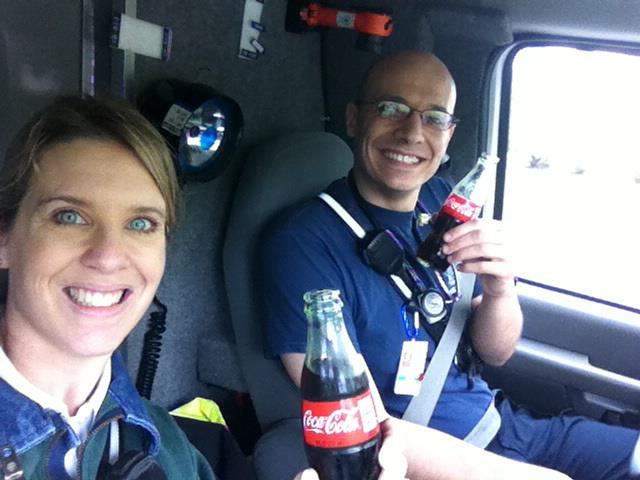
A few years ago on a hot Summer day, Amir and I were dispatched to a house for a child having a seizure.  The little girl had a history of frequent seizures, so her parents were pros at giving her Diastat, her emergency medication designed to stop a seizure.  By the time we arrived just a few minutes later, her seizure had stopped, and her Dad just asked that we check her vital signs.  He had spoken to her Neurologist who agreed she could stay home if her heart rate, blood pressure and breathing were all stable.  Fortunately, everything checked out ok, so the family was able to avoid another hospitalization.

As we collected the equipment and marched back downstairs, we heard the Dad pop the top on two bottles and shout “I really want to thank you both!”  Hoping not to embarrass or insult him, Amir and I discussed the best way to tell him we couldn’t accept an alcoholic “thank you” while on duty.  As we rounded the corner to the kitchen, we saw him holding two ice-cold bottles of Coca-Cola.  We drove away feeling appreciated and recharged – ready to take on whatever 911 call came next.

255764_10151483529319545_1320742665_n
The sweetest kind of “Thank You”

Hopefully you won’t have to have such a close encounter with your local EMS providers, but don’t let that stop you from giving the next crew you see a pat on the back.

~ Steph

5 Things I Learned in EMS I Wish I’d Learned in Medical School

Hello world. Mr. TeamLouka here.

I hear my wife started a blog… and in typical Steph fashion, three days later she has hundreds of viewers in 10+ countries?! Well, I can’t let her have all the fun, and its TEAMlouka afterall. So here’s my take on…


5 Things I Learned in EMS I Wish I’d Learned in Medical School

1. ABCs

Airway. Breathing. Circulation. Often boiled down to the ever-popular “air goes in and out, blood goes round and round, and any variation of either is bad.” Seems simple enough. You might even think such a simple, crucial concept would be covered on day one of medical school, just like it was in EMT class.

False.

I distinctly remember sitting in the auditorium at EVMS back in August 2010 and thinking to myself, “OK. Let’s do this. Doctor training, go!” The lecture topic? Intro to medical molecular cellular biology, of course! Because when that critical patient rolls in, all attention should be directed towards the golgi apparatus and endoplasmic reticulum first. Funnily enough, I didn’t leave that class feeling any more clever.

Now in all fairness, ABCs were covered in medical school. The problem is that the single most important concept in the assessment of an undifferentiated patient was sandwiched somewhere between memorizing The Krebs Cycle and the chapter on brain eating amoebas.

So out of four long, expensive years, just half a day was smushed in there for a shoddy BLS/CPR course. By that point, most of my compatriots had drunk the Kool-Aid – BLS was a boring day off for some and an unwelcome eviction from the library for others.

The effect? Time after time, I have watched medical students, residents, and even some attendings rack their brains for a diagnosis, visibly straining to remember what medicine or scan should be ordered next, when called to the bedside of someone going downhill. THE PATIENT ISN’T BREATHING. But is it multiple endocrine neoplasia type 1 or 2? THE PATIENT ISN’T BREATHING. Did she say her great-great-grandmother had psoriasis? I DON’T FEEL A PULSE. Did you do a rectal exam? MAYBE WHEN I FINISH THESE CHEST COMPRESSIONS.

(OK all you sticklers for AHA guidelines out there. I know it’s CAB now. But no one says that. It’s ABC. Forever).


2.  Acuity is just a number

In every ED there is some kind of triage coding system. Usually it’s a numerical assignment, 1-6 in ours, given to patients when they arrive, which roughly translate as:

  1. “We need a doc in here!”
  2. “Doc, my chest hurts since this morning.”
  3. “Doc, my belly hurts since yesterday.”
  4. “Doc, my toe hurts for the past 18 years.”
  5. “Need a med refill, Doc.”
  6. “He’s dead, Doc.”

We’ll that’s great when it works. But one EMS call in particular taught me to maintain a healthy dose of skepticism with those low acuity patients.

It was early in the morning. My partner and I had just signed on were still fueling up on coffee and pancakes. So when the call crackled over the radio for a priority 3 injury, “patient stubbed his toe,” we understandably finished our coffee and waited for the check. We drove to a house about 10 minutes away in no rush at all. Why the hell would someone call 911 at 6am for a stubbed toe?!

The question was partially answered when we walked into the house to find a pale, diaphoretic man sitting in his kitchen… holding a slightly bruised toe.

Turns out this guy walked outside to pick up his newspaper and collapsed down by the mailbox. He spent half an hour crawling back up the driveway, and at some point along the way managed to stub his big toe, much to his dismay. He also just happened to be having a massive heart attack.

Moral of the story: Lay eyes on the patient, then finish your coffee. Just in case.


3. Where Patients Come From

Well when diabetes and high blood pressure love each other very much…

No, that’s not what I mean. I mean physically, socially, emotionally. You see, most patients arrive to me looking more or less the same – propped up on a stretcher or in a wheelchair, clutching some form of puke receptacle, and flanked by a pair of overworked, underpaid EMTs and/or an overworked, underpaid nurse. They’ve usually been cleaned up a bit to meet some unwritten, undefined minimal standard and bare few traces from whence they came. By the time they get admitted upstairs, patients are in a standardized gown, on a standardized bed, eating a standardized turkey sandwich.

This creates a poorly recognized issue for us as doctors. We fail to see the idiosyncrasies of a patient’s life outside of the hospital and tend to place them into one of three broad categories: homed, homeless, or living in some kind of facility (nursing home, rehab, assisted living, jail – take your pick). Each of these then receives the ultimate American qualifier – insured or uninsured. That assignment basically dictates more about a patient’s care and treatment than their actual medical diagnosis. And it is horribly flawed.

Only through EMS did I have a first hand, and a first nose, perspective of just how different life can be for a fellow human being. I have clambered over mountains of hoarded garbage in what looked like a upper-middle class home from the street, been in nursing homes which would put North Korean labor camps to shame, and even pulled a young woman out of the bottom of a port-a-potty where she spent the night sleeping in a tub of chlorine and human waste. There is a spectrum to everything, and the circumstances of a person’s life leading up to his or her encounter with me can tell me as much or more about their condition, and what I can do about it, than the symptoms they describe.

I distinctly remember a call to assist a man complaining of some ambiguous pain complaint. He had just been discharged from the hospital that morning. But at well over 600lbs, he was entirely unable to care for himself at home. Never before, and never since, have my nostrils known such misery. He couldn’t fill his prescriptions, get a glass of water, or even get out of the bed to use the toilet. He was, literally, a mess.

The medics bringing me patients now have my full attention. I want to know what they know. They also have my respect – I know what their noses have been through.


4.  It’s their emergency, not mine.

This one is simple. Every person arriving in the ER is there because they feel that their condition – be it crushing, unbearable chest pain or thirty minutes of life-shattering hiccups – just cannot wait another moment to be addressed. But as a newbie EMT recruit, doing my EVOC and driver training, I was taught, on multiple occasions, a memorable and poignant philosophical lesson:

“Dude. It’s their emergency, not ours. Slow. The Fuck. Down.”

-Socrates, Field Training Officer

Now that might have had something to do with the pedestrians diving into the bushes every time we responded to a call, but it sticks with me. On a busy scene, with lights flashing, sirens of approaching units blaring, family and bystanders screaming in my ear, multiple patients and limited resources, the public looks to the collective “us” that is Police, Fire and EMS to take control of situation. In the ED that role shifts to the doctors.

Approaching even a critically ill patient, with nurses, medics and techs racing around grabbing equipment and medicines, my job is to remain calm, cool and collected. Allowing my own tumblr_ls44cgafCl1qaa241level of anxiety to meet that of my patient won’t get anything done more quickly and certainly won’t hasten the cure.
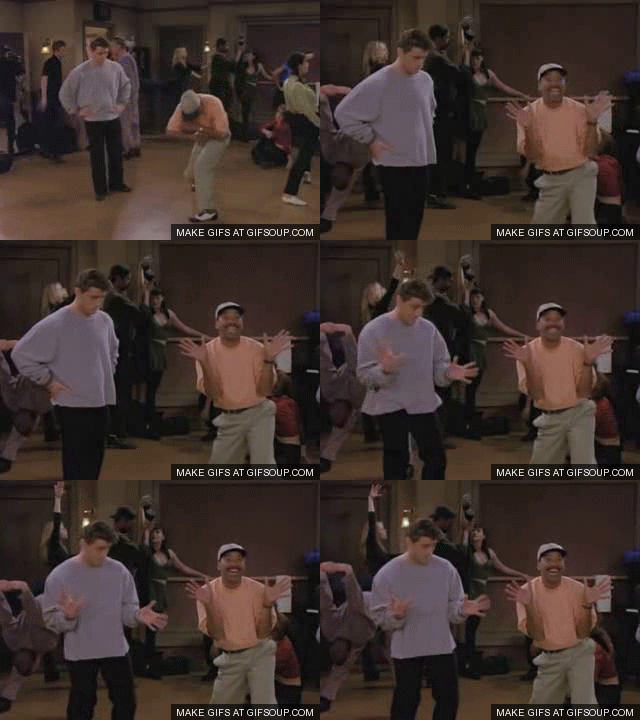
Unfortunately medical school does a terrible job of teaching this. Learning about the management of truly sick patients takes place more in the classroom than at the bedside. There is infinite time to think, weigh the options, and look up the answers. The student is usually sent to see the less acute patients, or tags along to observe when things get dicey. Then, day one, intern year, with that long white coat tickling the calves of someone who has never ordered morphine or a blood transfusion or called a surgeon in the middle of the night to say I need you down here now, many struggle when it comes to taking a step back. Looking. Listening. Thinking. Acting.

So when grandpa rolls in clutching his chest, don’t be alarmed if I’m not barking out orders like you’ve seen on TV. I’ll be at the bedside, taking his pulse, followed quickly by taking my own.

5.  Scene safe, BSI

If you had asked me five years ago for my thoughts about the pervasive mantra of EMT recruits everywhere, “Scene safe, BSI,” my response would have been an incomprehensible tirade of expletive filled muttering. I’ll wear gloves. I get it. STOP MAKING ME SAY IT. Every skills station, every practical exam, every day. As if the mannequin we were pretending to bandage had actually just escaped some Liberian Ebola quarantine zone and standing in the doorway with jazz-hands to show I remembered to put on my imaginary gloves would somehow protect me. F&*%#$#!

jazz-hands-o

For those of you who don’t know, BSI stands for “body substance isolation.” The idiom is a reminder to EMT students to look for potential danger first, to protect themselves and their partner before even attempting to help anyone else, and to wear gloves. One thing is certain – no one gets extra points for getting hurt on scene and doubling the number of patients, and if you get hepatitis, you lose.

While this definitely remains true in the hospital (i.e. Steph’s “nonverbal” psych patient who wasn’t talking because of the razor blade hidden in his mouth), it goes further than that. It’s a reminder to take care of ourselves, and each other, through the emotional and physical demands of our work. Believe it or not, watching people in pain and dying every day can be rather taxing on the psyche.

Medical school spends a lot of time teaching us how to help others through the process of aging, illness and, ultimately, death. We learn every aspect of disease, how various ailments ravage the body, each in their unique way. But little time is spent learning to carry the weight of our responsibility or dealing with the death of a patient.

In that respect, EMS excels. CISM (critical incident stress management) is a program which helps medics through the worst of calls. The team, staffed by members with specialized training, provides everything from one on one counseling to group debriefings. All hospitals should have such a system.

And for God’s sake put some gloves on when you go in the room. C diff is a terrible, terrible thing.


So that’s that. 5 things which make me a better doctor, all learned at the bottom of the medical totem pole. From the basics of taking care of someone else, to the more complicated task of watching out for myself, EMS has played a huge role in my training. Even as a doctor, I continue to learn on every shift, and that is what keeps me coming back for more.

~Amir

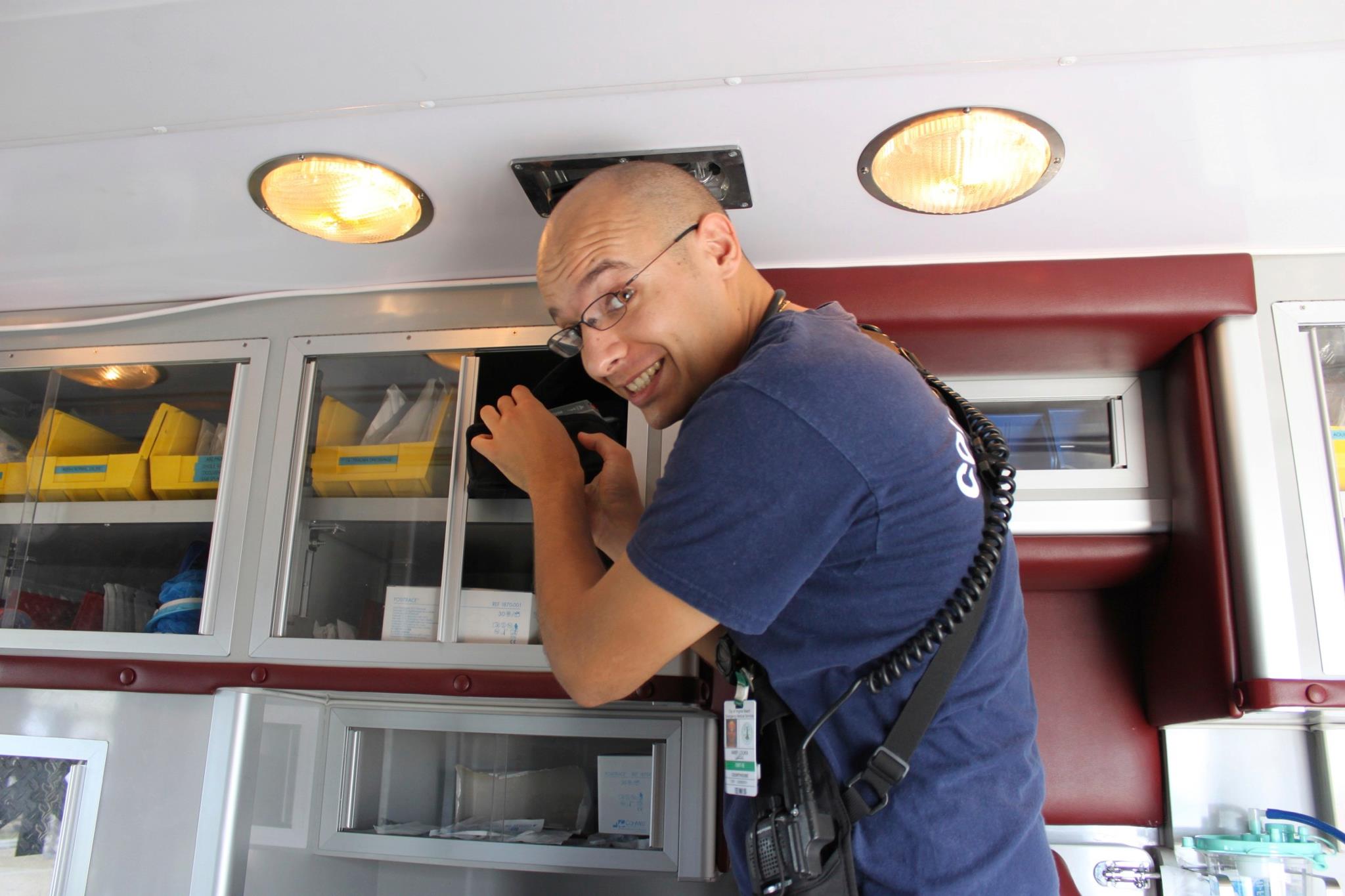
328441_817390815167_1572593932_o (1)