
Category: EMS

Caring for criminals: How to provide good medical care to people who have done bad things

As an Emergency Medicine Physician and EMS provider, I get a lot of questions about my job.  #1 “What’s the worst thing you’ve ever seen?”  #2 is “How do you stay motivated and not let it get to you?” And #3 is what I’ll address in this post, “How do you take care of murderers, rapists and other people who have done horrible things?”

It’s an unfortunately common scenario: high-speed MVC, multiple vehicles, one DOA (dead on arrival), two adults in critical condition, being flown by helicopter as the highest level trauma alert, alcohol involved.  And all too often, Paramedics, Nurses and Physicians have to take care of everyone involved, including the intoxicated driver that caused the mayhem.  How do you have compassion, empathy and care for someone that by all evidence just killed someone in a completely preventable way?  I’ve been in Emergency Medicine for 11 years, and I still struggle with this.  It’s never easy, but I’ve found a few strategies to help cope.

1. Don’t Ask, Don’t Tell

A few months back I was taking care of an ICU patient that I knew was a prisoner in a maximum security prison due to the vigilant watch by 2-3 armed security guards at all times.  Clearly he had done something bad, but for me, knowing exactly what would only potentially worsen the medical care I could give him, not improve it.  So I didn’t ask, I didn’t Google.  Unfortunately someone else did, and shared it with the whole team.

Turns out he beheaded a total stranger, a husband and a father of two, because he didn’t have cash in his wallet when he tried to rob him.  Once I learned that, I couldn’t unknow it.  I struggled to walk in his room each morning with a smiling face and open, non-judging mind.  For the human in me, it was a battle I had to consciously fight.  My advice to anyone who might care for inmates or anyone in police custody, don’t ask, and encourage the whole team not to ask.  And if you find out, don’t tell.  99% of the time it’s not relevant to patient care, and can only cause you (and everyone else on the team) to make mistakes.

2. Be an Advocate

Incarcerated people have difficulty accessing medical care.  Although prisons and jails have a medical clinic, studies show that prisoners get less frequent and timely care for both chronic and acute conditions.  A 2009 report published in the American Journal of Public Health, unearthed some worrisome stats:

  • “Among inmates with a persistent medical problem, 13.9% of federal inmates, 20.1% of state inmates, and 68.4% of local jail inmates had received no medical examination since incarceration.

  • Prior to incarceration, slightly more than 1 in 7 inmates were taking a prescription medication for an active medical problem routinely requiring medication (as defined in the Methods section). Of these, 3314 federal (20.9%), 43 679 state (24.3%), and 28 473 local jail inmates (36.5%) stopped the medication following incarceration.

  • Only a small portion of prison inmates (3.9% of federal and 6.4% of state inmates) with an active medical problem for which laboratory monitoring is routinely indicated had not undergone at least 1 blood test since incarceration. However, most local jail inmates with such a condition (60.1% [SE = 1.8%]) had not undergone a blood test.

  • Following serious injury, 650 federal inmates (7.7%), 12 997 state inmates (12.0%), and 3183 local jail inmates (24.7%) were not seen by medical personnel.

Incarcerated persons have to “prove” to prison staff they are truly sick and need to go to the Emergency Department.  Yes, many prisoners fake or exaggerate symptoms for the secondary gain of getting a break from behind bars: better eye candy, different food, and maybe some good pain medication.  But, 38-43% of inmates have chronic medical conditions, which by all evidence, may not be properly addressed and managed by the prison clinic.  When these patients present to the ED, I play it safe and assume they have been sick a few days longer than a regular person, as they probably had to fight to make their case to prison staff.  Guilty or innocent, these patients all need an advocate for their medical care.  I take pride in being that person, which allows me to keep my personal judgements out of the encounter.

3. We are guilty, too

Last week I took care of a woman addicted to IV heroin.  By all accounts, she was pitiful looking – shivering, sweating, unable to sit still.  She was also curt, demanding and liked to cuss at us.  The medical student with me asked how someone could make such poor choices and then be so demanding.  I didn’t disagree, and I found myself starting to judge.  I had to redirect my thoughts and remember that prescription opioids can be a gateway to heroin for many people.  Heroin is 1/10th the cost of prescription drugs bought on the street.  People get hurt or have surgery, and we (doctors, NPs and PAs) prescribe them pain medication.  When people can’t afford their prescription drug addictions, they turn to the cheaper alternative.  And who writes the most prescriptions for these drugs?  Us. We contribute to this, so we need to accept treating it.

handcuffs

That’s my limited advice.  It’s still a daily struggle, with some days easier than others.  Do you have any tips to offer on how to approach this difficult patient population?  If so, I’d love to hear them.  I encourage you to comment below.

~Steph

Be Heard in the Bay: Tips for Turnover on Critical Patients

Apparently 12-1 is not an acceptable ratio when it comes to his & hers blogging… So in the interest of continued marital harmony, here’s a few thoughts to newbies on making yourself heard in the resus room.


It happens to the best of us. You’ve been sitting around the station all night and finally decide it’s safe to slip the boots off, only to be immediately reminded that the trauma gods do in fact enjoy tormenting you. On come the lights, quickly followed by a dispatcher’s pressured voice. As you glance at the clock reading 3am, a few words stand out. Gunshot wound. Bleeding. Unconscious.

For the next fifteen minutes you’re on autopilot – reflexively cutting away clothing, occluding that bubbling hole in the chest and dropping a needle down through the second intercostal space, just like you were trained. You watch the vital signs move back towards normal and you justifiably feel like a total badass. Time to load and go.

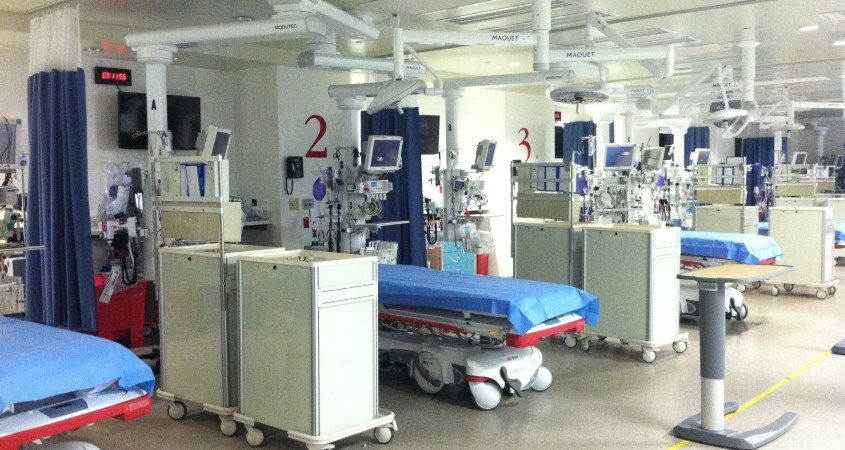
As you wheel into the trauma bay at your local Level 1, you’re confident you’ve done everything right. There’s the team, gowned and gloved, ready to take over.

IMG_1105 (1)

“………..”

Inside your brain is screaming, “Work mouth, you bastard!” Now is the time to prove to all these doctors how awesome you are, how you saved this guy’s life. “I’ve done all the hard work. Speak damn you!”

“Ummm.. This is Steve, he’s a male..”

“SPEAK UP.”

“Steve! He’s a male! And.. we found him outside the bar – the one over off Main, well Main and 3rd… closer to 4th. He has asthma and…”

“Airway’s patent! Breath sounds clear bilaterally!” It’s too late. You lost them.


Want to keep the brief attention of your ED colleagues and trauma team? Here’s how:

1. Figure out who’s doing the talking – most critical patients roll in flanked by a entourage of medics, EMTs, fire fighters and/or police. Add to that the near-limitless helping hands in a large ED and there’s usually no need for the AIC to be occupied with distracting tasks like moving the patient off the stretcher or switching O2 from the portable tank to wall supply. Instead, the AIC should be at the foot of bed, addressing the entire room. Yes, everyone – the doctors, nurses, techs, social worker, chaplain and ogling med students ALL need to hear what’s going with this guy, so be ready to project your voice and speak clearly.  And if you are the trainee, don’t disappear to clean the stretcher – stick around and listen.  It’ll be your turn before you know it.

2. Take a deep breath – You made it. Even if the patient is actively coding, you’re here and your job is almost done. The blood splattered sidewalk, flashing lights, noise and confusion are all behind you. It’s our job to shut up and listen, and we will – for about 30 seconds. Starting your turnover in a calm and collected manner is the first sign to us those precious seconds will be well spent.

3. Age. Sex. Chief complaint/most pressing issue. – The first two always go off without a hitch. The third seems obvious, but every now and then it just takes an inexplicably long time to get around to mentioning the multiple stab wounds or EKG reading ***STEMI***STEMI***STEMI***. By the end of your first sentence we should know who your patient is and what went so wrong with their day to now be spending it with all these highly trained individuals.

4. Stay focused – This is not the time for an exhaustive presentation of the history and physical. A remote history of paronychia isn’t of much interest in someone with hemiparesis, but the time of onset certainly is. We can wait to hear she takes 500mg of Vitamin C daily, but Coumadin is a med I want to know about up front. By far this is the most difficult thing to master, because it often means reading our minds, knowing what’s important and what isn’t. A few stand out items in no particular order would be: loss of consciousness yes or no, symptoms improving or worsening, mechanism of injury, relevant surgeries, and medications including blood thinners, cardiac drugs such as beta blockers, and insulin.

5. Vitals – What are they now? Were they different at any time? What do you mean you only got one set?

6. Injuries, EKGs, physical exam and what did you do about it? – This is your chance to brag. “Patient was altered and EKG showed sinus bradycardia. I gave 0.5mg Atropine x1 with improvement in heart rate and mental status.” “The right leg was shortened with deformity at the mid-thigh. I gave 100mcg of Fentanyl and applied a traction splint.”

7. Access – ET tube, King airway, NPA? What size IVs and where are they? Did you drill IOs instead? Kudos if you did.


That’s it really. In 15-30 seconds we should hear what’s wrong with this person, how did it happen, what changes happened while he/she was with you and what did you do about it.

Giving a concise, accurate turnover takes practice. The pressure is on and your adrenaline is already up. You’re mentally exhausted, but those last few moments before he or she is off your stretcher are often the only insight doctors get into what’s going on, so make them count. Once the dust has settled, feel free to pull any of us aside for some feedback.

~Amir

FullSizeRender (6)

Cardiac arrest survival story that’s close to home

Dr. Joseph Ornato is a well-known name in EMS here in Virginia and across the country.  If you don’t know him, he’s the Operational Medical Directory (OMD) for Richmond Ambulance Authority (RAA).  On a personal note, he also happens to be the Chair of the Department of Emergency Medicine at VCU where Amir and I are in residency.  If you have 30 minutes to spare, this is a great podcast interview of Dr. Ornato telling the story of how many of the technologies and protocols he initiated came together like a symphony to save his own life.

http://www.emsworld.com/podcast/12089587/word-on-the-street-when-your-medical-director-is-your-patient

A few thoughts on drowning events

For 8 amazing summers, I worked as a lifeguard at Ocean Breeze Waterpark in Virginia Beach, VA.  Some of the best memories in my life are from those days.  However, unlike most lifeguard jobs – we actually saved drowning people, and A LOT of them, roughly 10-12 per day. I stopped counting my “saves” somewhere around 300.  Looking back, this job was what lead me to EMS, and ultimately to becoming an Emergency Physician.  The training provided by  Ellis & Associates (E&A) created a great foundation of water rescue, first aid, CPR and leadership skills.

E&A Eastern Regional Lifeguarding Competition - Summer 1998
E&A Eastern Regional Lifeguarding Competition, 1998

On a side note, you may be wondering how so many people can get into trouble at a water park.  It’s not like the ocean, right?  Well, I think as a society we have an inherent respect, and maybe some fear, of the ocean.  Pools however, are clear and don’t have critters, so how dangerous can they be?  People and parents let their guard down and get into trouble.


Are you a good lifeguard?

Before you read any further, I encourage you to take a little test.  The two videos below both feature wave pools where there are active drowners.  It’s like a high-stakes Where’s Waldo – can you spot the drowning victim?  See if you could do the job.

Did you see the kids before the lifeguard blew the whistle to jump in?  The kid in the first video has pretty obvious flailing; the kid in the second video – much more subtle.  There’s been a great Slate.com article circulating around Facebook the last few months creating awareness that drowning doesn’t always look like what we expect.


Drowning Definitions

Before we get too deep into the medicine, let’s first talk terminology.  Many of the terms I learned as a lifeguard have fallen out of favor in the medical community.

Drowning: a process resulting in primary respiratory impairment from submersion/immersion in a liquid medium

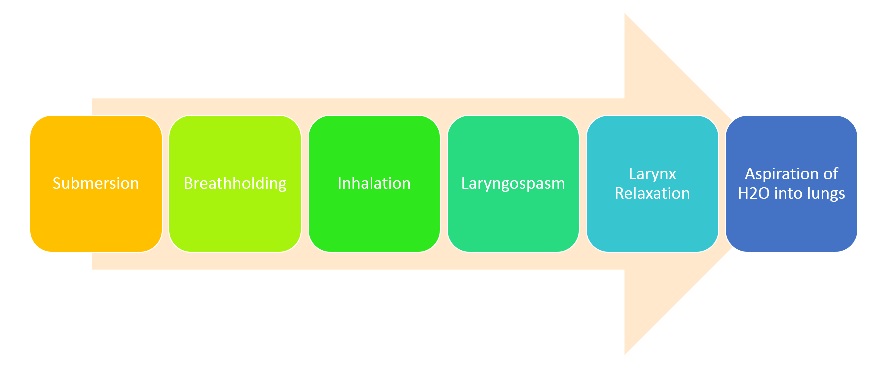
The Drowning Process: the period beginning with submersion into liquid, followed by breathholding.  As oxygen is depleted and CO2 can’t be expired, the patient begins developing hypercarbia (high CO2), hypoxemia (low O2), and acidosis.  As water is inhaled, the larynx spasms shut, blocking the exchange of air.  As oxygen drops further, the laryngospasm relaxes, and the patient breathes water into the lungs. Recovery from the drowning process depends on when interventions are made and the resultant level of hypercarbia, hypoxemia, acidosis and encephalopathy.

drowning process
The Drowning Process

Terms no longer used:

“Dry drowning” versus “wet drowning”: all drownings require some level of liquid, so they are all technically wet.  What was traditionally called a “dry drowning” was just someone who made it to the laryngospasm step but no further because they left the water.  “Wet drownings” went through a laryngospasm period, but advanced in the process to include inhalation of water into the lungs.


Managing Drowning Victims

You should of course follow your local protocols, but let’s talk about how the drowning mechanism affects care.  Clearly if the victim has no pulse, you’ll follow ACLS/BLS guidelines and start CPR.  If you get to a victim but can’t initiate chest compressions right away because you are oh I don’t know – in the middle of the ocean or a wave pool – at least try to give rescue breaths as you bring the victim to a more suitable place.  Remember, drowning is primarily an airway issue, so any early airway interventions will be beneficial until you can start CPR.  As of the 2010 AHA CPR updates, abdominal thrusts in a coding patient have been discarded for good old chest compressions.  So, if your drowning victim isn’t breathing, even if they have a pulse you may need to do chest compressions for management of A&B.

Regarding when to intubate, per UptoDate, “in the symptomatic patient, indications for intubation include the following:

  1. Signs of neurologic deterioration or inability to protect the airway
  2. Inability to maintain a PaO2 above 60 mmHg or oxygen saturation (SpO2) above 90 percent despite high-flow supplemental oxygen
  3. PaCO2 above 50 mmHg” which is typically unavailable prehospital.

Whether someone was pulled from fresh or salt water is not particularly relevant to prehospital care as it doesn’t change management. Consensus used to be the patients in salt water were at risk for massive pulmonary edema and electrolyte imbalance in the blood as the high sodium content of the salt water shifted in the body.  The risk and consequences of these shifts are now less worrisome than once thought.  In a 150lb (70kg) person, it actually takes inhaling 5.5 cups of water before you’ll see osmotic water shifts in the body, and twice that before you’ll see electrolyte shifts.

The greatest risk of drowning of any type is hypoxemia leading to brain damage, and they key strategy is drowning prevention.


Drowning Prevention

Prevention is by far the best strategy in managing drowning, and in the last 20 years, smart safety measures and public education programs have helped drop the overall incidence of drowning by 9%, which includes a 45.6% drop for infants (< 1 yr of age).  In fact, my good friend David Andrews who runs a water park out in California, told me that since the water park industry implemented a policy requiring kids <48″ to wear life jackets, active drowning events have declined roughly 50%.


So, if you are taking care of a drowning victim in your ambulance or ED, just follow your ACLS protocols.  And, next time you are at the water park or pool, thank the lifeguard for their diligence and dedication, and please don’t complain that your kid has to wear a lifejacket.

~Steph

When people fall from extreme heights

I’m currently on a month of Ortho nights and was asked by the Attending to look up an article about the median lethal dose (LD50) for falls, meaning, at what height when people fall, do 50% of them die.  Although 10 years old, the article is pretty interesting and got me thinking about some fall patients I’ve taken care of in the past.  I once had a patient who accidently fell 11 stories from a hotel and lived.  But we’ll get back to that story in a bit.

A fun fact before we dive in:

The record for a fall from the greatest height where the person survived is held by Alan Magee, a WWII USAF pilot who jumped out of his plane at a startling 24,000 feet and landed in a pine forest (some sources say a glass roof).  Fortunately for him, the forest (or the roof) was covered in snow which is believed to have decreased the energy of the impact due to its deformability.  If you are looking for a great book about a fall survivor, check out When I Fell From the Sky, by Juliane Koepche, a 17 year old girl who fell 10,000 feet from her family’s airplane which ultimately crashed in the Amazon jungle in 1971.

When I Fell From the Sky (front).grid-4x2

The evidence on falls

The article, Prognostic factors in victims of falls from height, by Lapostolle et al, was published in Critical Care Medicine in 2005.  The study took place in France, in a city near Paris with a population of 1.3 million people.  The researchers worked with the local EMS agency, Service d’Aide Médicale Urgente (SAMU), to examine both pre-hospital and in-hospital mortality (death) from falls, with the goal of determining what characteristics of a fall, if any, factor into prognosis.  There were 287 patients in the study, 97 (34%) of which ultimately died.  In short, they determined that patient age, height of fall (e.g. 1 story vs 8), impact surface type (e.g. concrete vs snow) and body part that first touches the ground (e.g. head vs legs) all help predict how a patient will do.

Interestingly enough, they even looked at the circumstances leading to the fall (i.e. accident, suicide, escaping a burning building), and cause did not factor in to prognosis.  When you stop and think about it for a second, it seems semi-reasonable that someone determined to commit suicide might be able to jump in such a way to be more successful in his mission.  Yet, of the 123 patients who attempted suicide, only 45.5% were successful.  So suicide was not more deadly of a fall.

Also of interest, landing feet first was much less deadly than landing on your stomach, with death rates of 5.6% and 57.1% respectively.  Getting back to my patient who fell 11 stories and lived, he fell feet first.  I believe he survived because his legs acted as a sort of crumple zone, absorbing some of the energy of the impact.

Figure 1. Height of fall and related mortality.
Figure 1. Height of fall and related mortality. Lapostolle et al.

Figure 1 above is from the article, and shows what’s known as the median lethal dose (LD50) for falls, meaning, at what height of a fall will 50% of people die.  In this study, it was determined to be just over 4 stories.  You can see that in this study, with the exception of one person who fell 17 stories, 100% of the patients who fell from 8 stories or more died.  Clearly there are exceptions to this in real life – the 17 story patient, my patient, Mr. Magee, Ms. Keopche – but statistically speaking, it’s extremely rare.  So, next time you respond to a call or see a patient in the ED who fell 4 or more stories, know that they have a 50/50 chance of survival.


Sorry for the morbid topic, but that’s part of being on night shift I suppose.

~Steph