For years, when evaluating a patient for thrombolytic therapy, emergency clinicians have been trained to ask about blood thinners. There is now another medication history we need to know.
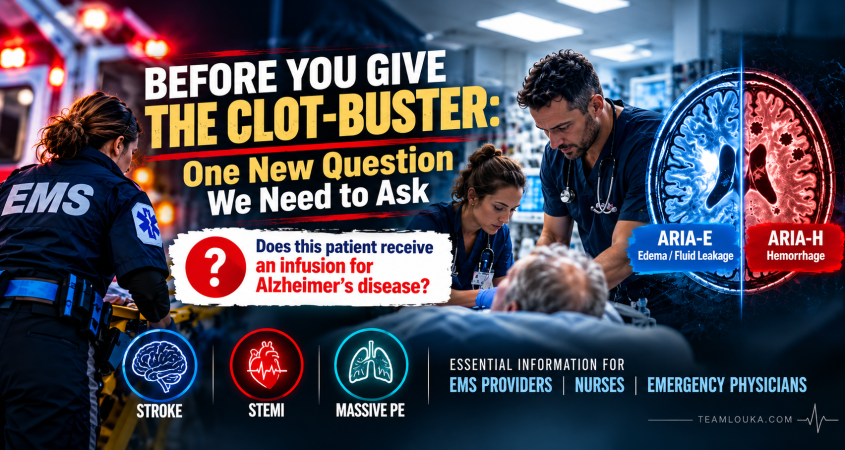
“Does this patient receive an infusion for Alzheimer’s disease?”
That seemingly small question may have major implications for emergency stroke care—and potentially for other emergencies in which thrombolytics are considered.
A new generation of Alzheimer’s treatments
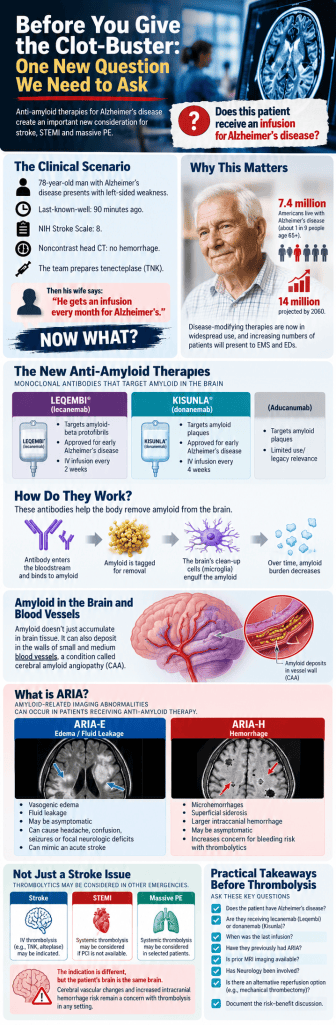
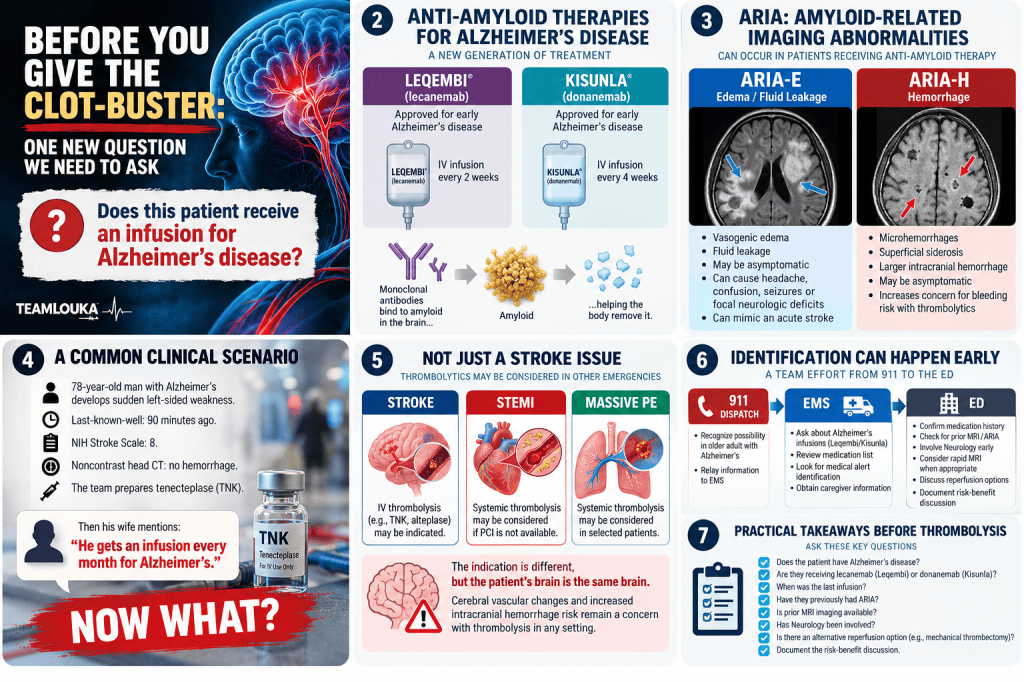
Two newer medications, lecanemab (Leqembi) and donanemab (Kisunla), are monoclonal antibodies used to slow the progression of early Alzheimer’s disease. Rather than simply treating symptoms, these drugs target amyloid in the brain and help the body remove it. Impact of Anti-amyloid therapie…
That is an exciting development in Alzheimer’s treatment.
But it creates a new challenge for emergency medicine.
Amyloid doesn’t accumulate only in brain tissue. It can also deposit within the walls of cerebral blood vessels—a condition known as cerebral amyloid angiopathy. Impact of Anti-amyloid therapie…
As anti-amyloid antibodies help clear amyloid, some patients develop ARIA: Amyloid-Related Imaging Abnormalities.
There are two major types:
ARIA-E involves edema or fluid leakage.
ARIA-H involves hemorrhage, including microhemorrhages and other bleeding-related changes.
Most ARIA is asymptomatic, but symptomatic patients may develop headache, confusion, seizures or focal neurologic deficits—the last of which can look remarkably like an acute ischemic stroke. Impact of Anti-amyloid therapie… Impact of Anti-amyloid therapie…
And that creates a potentially dangerous dilemma.
When ARIA looks like a stroke
Imagine this:
A 78-year-old man with Alzheimer’s develops sudden left-sided weakness. His last-known-well was 90 minutes ago. His NIH Stroke Scale score is 8. His noncontrast head CT shows no hemorrhage.
The team prepares tenecteplase (TNK).
Then his wife casually mentions:
“He gets an infusion every month for Alzheimer’s.”
Does that change anything?
It should at least make us stop and investigate. Impact of Anti-amyloid therapie…
Patients receiving anti-amyloid therapy may have underlying cerebral vascular changes that aren’t apparent on a routine noncontrast CT. ARIA is evaluated with MRI, and administering a thrombolytic to a patient with vulnerable cerebral vasculature may increase the risk of catastrophic intracranial hemorrhage. Fatal hemorrhages following thrombolysis have been reported in patients receiving anti-amyloid therapy. Impact of Anti-amyloid therapie… Impact of Anti-amyloid therapie…

So are thrombolytics contraindicated?
This is where things get complicated.
There is not yet one universally adopted protocol. Recommendations differ, and practices can vary between institutions and even clinicians.
The American Heart Association Stroke Council has advised avoiding thrombolytics in patients receiving anti-amyloid immunotherapy until safety data are available. Published appropriate-use recommendations for donanemab recommend against IV thrombolysis without a pretreatment MRI unequivocally excluding ARIA. FDA guidance also emphasizes considering whether focal neurologic symptoms could actually represent ARIA-E before thrombolytic treatment. Impact of Anti-amyloid therapie…
That doesn’t mean we stop treating stroke.
It means we need to know who is receiving these drugs before making a time-critical reperfusion decision.
Mechanical thrombectomy may still be an option for appropriate patients. Neurology consultation, review of previous imaging and, when appropriate and feasible, rapid MRI may become increasingly important pieces of the emergency stroke pathway. Impact of Anti-amyloid therapie…
This isn’t only a stroke issue
Thrombolytics aren’t exclusive to stroke.
Consider a patient with a STEMI presenting somewhere without immediate PCI capability. Or a patient in shock from a massive pulmonary embolism.
Systemic thrombolysis may enter the discussion in either situation.
The indication is different, but the patient’s brain is the same brain.
The possibility of vulnerable cerebral vasculature and intracranial hemorrhage doesn’t disappear simply because we’re giving the thrombolytic for a heart attack or pulmonary embolism instead of a stroke. Impact of Anti-amyloid therapie…
The practical takeaway
We have spent decades teaching clinicians to look for anticoagulants before giving thrombolytics.
Now we need to recognize another category of patient: someone who may have unusually fragile cerebral vasculature because of Alzheimer’s disease and anti-amyloid treatment. Impact of Anti-amyloid therapie…
For EMS and emergency clinicians, the medication history needs to evolve accordingly.
When an older patient with Alzheimer’s or cognitive impairment presents with a possible stroke—or another condition in which thrombolysis may be considered—ask specifically:
- Do they receive an infusion for Alzheimer’s disease?
- Is it lecanemab/Leqembi or donanemab/Kisunla?
- When was the last infusion?
- Have they previously had ARIA?
- Is prior MRI imaging available?
- Has Neurology been involved before thrombolysis is given?
My ED checklist also includes considering alternative reperfusion options and documenting the risk-benefit discussion. Impact of Anti-amyloid therapie…
This information needs to be identified before the patient reaches the point of a thrombolytic decision whenever possible. That means educating not only emergency physicians, but also dispatchers, EMS clinicians, nurses, neurologists, cardiologists, radiologists—and patients and caregivers themselves.

One question worth remembering
Anti-amyloid medications represent an important advance in Alzheimer’s treatment. But as these therapies become more common, their effects will increasingly intersect with emergency care.
We don’t need every EMS clinician or emergency physician to become an expert in Alzheimer’s immunotherapy.
We do need them to recognize the medications.
So the next time you’re evaluating a patient with Alzheimer’s disease for thrombolytic therapy, don’t stop after asking about Eliquis, Xarelto or warfarin.
Ask about the Alzheimer’s infusion.
That one piece of medication history could fundamentally change the next decision you make.
~Steph